
In my last article, we explored what makes retrospectives valuable. We defined three major external factors: dedicated time, frequency, and taking outcomes seriously . Having all it set, now, we shift our focus to the retrospective meeting itself.
Within this article, I will first define the general approach cultivated by most organizations. Next, based on my experience, I will diagnose common issues that occur when running retrospectives.
The standard way
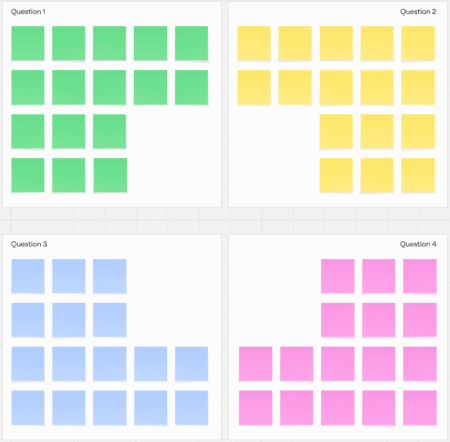
Does the picture above look familiar to you? We may use different tools such as EasyRetro or Miro to set up our own boards. However, ultimately, we use them in the same way. I will describe the standard usage in a few words.
Every retrospective board is split into either columns or boxes. Each column or box represents a question that we would like to explore with the team. The questions may vary among the teams, but more or less, the meaning is the same. Some examples of questions:
- What went well?
- What went wrong?
- .What can be improved
- What are the future risks?
This is not a complete list, but these are typical questions you can find in articles describing how to run a retrospective. You may find variations where, instead of questions, there are three words: Start, Stop, and Continue. Nevertheless, they convey the same meaning.
At the beginning of the meeting, we give people a certain amount of time to put their notes into particular boxes/columns. Then, we go through each note. Next, we sort them and merge duplicates. Once all the notes are sorted, we vote on them to find the most important ones from the team’s perspective. Once the voting session is over, we order the notes by number of votes and start discussing them one by one. We aim to finish discussing each note with an outcome that we want to cultivate in the next period. We end the meeting with a list of action points.
That would be a short description of a how retrospectives are run. This does not mean your organization follows this exactly. However, the differences are usually negligible.
Is this the final form of a retrospective?
Such a retrospective has been the standard for years in the IT industry. The question that comes to my mind is: have we reached a perfect model of how we can run retrospectives? Is there nothing that we can improve?
To be honest, it would be really weird if we reached perfection in any area. In real life, we can be sure of one thing: nothing is perfect, and everything can be improved..
Before diving into concrete improvements, let’s diagnose the imperfections in the current approach.
Issues with the standard retrospective
Issue #1: Unclear goal of the meeting
The issue might not be so obvious when you first read it. However, many teams do not focus on the sprint goal when running a retrospective. Loose thoughts are thrown around about what the team can improve. In many cases, they might be right, but how do we know if such improvements are something we should prioritize over other improvements? There is no straightforward answer to this. Therefore, without clearly highlighting what we want to achieve in the retrospective, it is hard to assess if the defined action points will deliver any value.
Issue #2: Endless ceremonies
The current format implies certain stages of retrospective. First, we put in notes, reveal them, read them, sort them, vote on them, and then finally, we discuss them to turn them into outcomes. The entire crux of the retrospective is done in the last 20% of time of the meeting. I attended some meetings where we barely had time to discuss them because there were so many notes and these ceremonies took too much time. We can ask ourselves: Is this the only wat to get tangible action points?
Issue #3: Taking the stage
One consequence of not clearly defining the goal at the beginning and then putting up unrelated notes is that matters are brought up that should be discussed outside of the retrospective. At some point, voting is meant to help us focus on the most important notes. But is it not the case that people are voting on things that resonate with them personally rather than voting on things that are more closely tied to the meeting goal? It happens quite often that people raise issues on a more personal level and then take the stage and other people’s time. However, this doesn’t bring us closer to our goals as quickly as we want.
Issue #4: Format not matching team dynamics
Is the format of using notes the best for every team? Such a format was created to encourage all people to share their opinions, to avoid anchoring bias, and for many more valid reasons. However, does it mean that this format suits all teams?
As we know, each team is made up of different personalities and people with diverse levels of experience. Additionally, we need to take into account how long people have been working together and how well they collaborate. In other words, we have to consider team dynamics. Therefore, the format with notes might not actually support discussion as much as it should be. Maybe your team would benefit more if you had a more open discussion? Yet no one stops to question whether the format they’re using is suitable for their team.
Issue #5: Unclear notes
A lot of notes are added with very good intentions. However, do all of them bring value to the discussion? Let me give you an example. Very often, we can see a note about good collaboration. Don’t get me wrong it is very nice that someone mentions it. Nevertheless, is the retrospective meeting for that? We can say yes, it is, but only if we define what good collaboration means and dive deeper into what was good about it. Unfortunately, from my experience, it usually ends up with just stating it. On the other hand, do we have to wait until the retrospective to sat that we enjoyed working with the team and we appreciate the team’s effort? Why not cultivate a habit where people can say something like this at the end of the daily meeting?
Summary
The retrospective is one of the most important meetings through the entire development cycle. I don’t think anyone doubts its value. What is more surprising is that this is the meeting we can improve the most among all the ceremonies we have in place. However, for some reason, we don’t do it and we blindly follow the guidelines.
I’ve outlined what I see as the issues in the retrospectives I’ve attended so far. In your case, these might not have been issues at all. But I really encourage you to sit with your team and discuss the current format. Let’s do a retrospective on retrospectives!
When I started writing the article, I had the intention also define solutions for those issues. However, with each character I typed the article was getting longer and longer. Finally, I decided to split it into two parts. In the next article, I will propose solutions for the issues diagnosed earlier.